Ciudad amurallada · Centro and San Diego
Cartagena walled city: two walks, at the right hours
The Cartagena walled city is best walked twice, at the hours the heat of Cartagena, Colombia allows. In the morning, loop through the streets of Centro and San Diego before the heat: in February from 7:00 to about 9:45, in October from 6:00 to about 8:00. The loop is 3.1 km, about 47 minutes on foot plus your stops. The two paid museums open at 9:00, after the cool hours have ended in most months, so walk first and go inside after. On a cruise ship day the plazas are busier through the middle of the day. Spend midday in a museum, over a long lunch or by a pool; short walks in the shade are fine. An hour before sunset, climb the sea wall and walk it north as the sun goes down. The walls are free, and you do not need a guide to find your way.
I stayed inside the walls for part of my 12 days in Cartagena in October 2023. Rainer Lang, editor
Some links on this page are affiliate links: the guide earns a commission when you book through them. The partner sets the price; the guide adds no fee.
1The plan
Two walks on one plan
November
Morning loop6:00 to about 8:00
On the walls16:35 to 18:05
The morning loop, 3.1 km
- Clock Tower gate
- Plaza de San Diego
- Las Bóvedas
- Teatro Adolfo Mejía
- Plaza Santo Domingo
- Cathedral
- Plaza de Bolívar and the Inquisition palace
- San Pedro Claver
- Plaza de la Aduana
Back to the Clock Tower gate after 3.1 km: about 47 minutes at 4 km an hour, without stops.
The walls at sunset, 1.6 km
About 24 minutes of walking along the top of the wall.
The morning loop keeps to the narrow streets inside the walls. The evening walk stays on the sea wall, where the breeze reaches you and the sun sets over the water. For the whole city on one sheet, see the Cartagena map.
2The hours
Your month, hour by hour
In November, start the loop by 6:00 and finish by about 8:00, when the streets pass 35 °C (95 °F) felt in still air. The loop itself is 47 minutes of walking, with time for long stops. Climb the wall at 16:35; the sun sets at 17:37; come down by 18:05. The wall starts warm and drops inside the line at about 17:45. 15 ship days this month: on those, expect more people in the plazas through the middle of the day.
- The two walks
- The hot hours in the streets
- Felt in still air
- With the sea breeze
- Ship in port
The line this page uses is the guide’s own, not a health authority’s. Inside the walls the houses block the wind, so the morning loop counts still air: walk while it feels like 35 °C (95 °F) or less. On top of the walls you get the breeze, and the line is 33 °C (91 °F) or less with it.
A dry month, February. The streets stay below the line until about 9:45, so a 7:00 start gives you 165 minutes: time for the loop and long stops. At noon it feels like 36 °C (97 °F). The sun sets at 18:10, and on the wall it feels like 29 °C with the breeze, inside the line.
A wet month, October. The cool part of the morning is short: from 6:00 to about 8:00, a window of 120 minutes for a loop of 47 minutes. Start at first light and keep the stops for later. Rain falls on about 12 days of the month, by the national weather service’s 1991 to 2020 normal. At sunset, 17:45, the wall still feels like 36 °C in still air and just over 33 °C with the breeze; it drops inside the line only at about 23:00, after dark. Go up for the sunset itself and walk the long stretch later.
All twelve months
| Month | Loop | Felt at the start | On the walls | Felt at sunset | Ship days |
|---|---|---|---|---|---|
| January | 7:00 to about 9:45 | 30 °C (86 °F) | 16:55 to 18:30 | 30 °C (86 °F) | 22 |
| February | 7:00 to about 9:45 | 30 °C (86 °F) | 17:10 to 18:40 | 29 °C (84 °F) | 17 |
| March | 6:30 to about 9:15 | 31 °C (88 °F) | 17:10 to 18:45 | 30 °C (86 °F) | 14 |
| April | 6:00 to about 8:15 | 32 °C (90 °F) | 17:10 to 18:45 | 32 °C (90 °F) | 17 |
| May | 6:00 to about 7:15 | 33 °C (91 °F) | 17:15 to 18:45 warm | 34 °C (93 °F) | 2 |
| June | 6:00 to about 7:15 | 33 °C (91 °F) | 17:20 to 18:55 warm | 34 °C (93 °F) | 3 |
| July | 6:00 to about 7:45 | 33 °C (91 °F) | 17:25 to 19:00 warm | 33 °C (91 °F) | not in schedule |
| August | 6:00 to about 7:30 | 33 °C (91 °F) | 17:20 to 18:50 warm | 33 °C (91 °F) | not in schedule |
| September | 6:00 to about 7:15 | 33 °C (91 °F) | 17:00 to 18:35 warm | 34 °C (93 °F) | 6 |
| October | 6:00 to about 8:00 | 33 °C (91 °F) | 16:45 to 18:15 warm | 33 °C (91 °F) | 11 |
| November | 6:00 to about 8:00 | 32 °C (90 °F) | 16:35 to 18:05 warm | 33 °C (91 °F) | 15 |
| December | 6:30 to about 9:00 | 31 °C (88 °F) | 16:40 to 18:15 | 32 °C (90 °F) | 18 |
Start and finishThe loop starts two and a half hours before the streets pass the line, never before 6:00 or after 7:30. The wall walk runs from an hour before sunset to half an hour after.
MuseumsThe two paid museums on the loop open at 9:00 on weekdays. Sunday hours are shorter: see stops 7 and 8.
The yearFor the whole trip, rain and sea included, see the best time to visit Cartagena.
3Morning
The morning loop, stop by stop
Nine stops, counterclockwise from the Clock Tower gate. Beside each number: the distance walked from the start. The two museums open at 9:00, so walk the streets first and step inside as they open.
- 0.0 km
The Clock Tower gate and Plaza de los Coches
The yellow tower over the Puerta del Reloj marks the main entrance to the walled city. A clock was first fitted in it in 1874. Through the arches lies Plaza de los Coches, where, as the city’s history museum records, enslaved people were auctioned and sold in colonial times. Just outside the gate, the busts on the Camellón de los Mártires honor nine patriots executed in 1816.
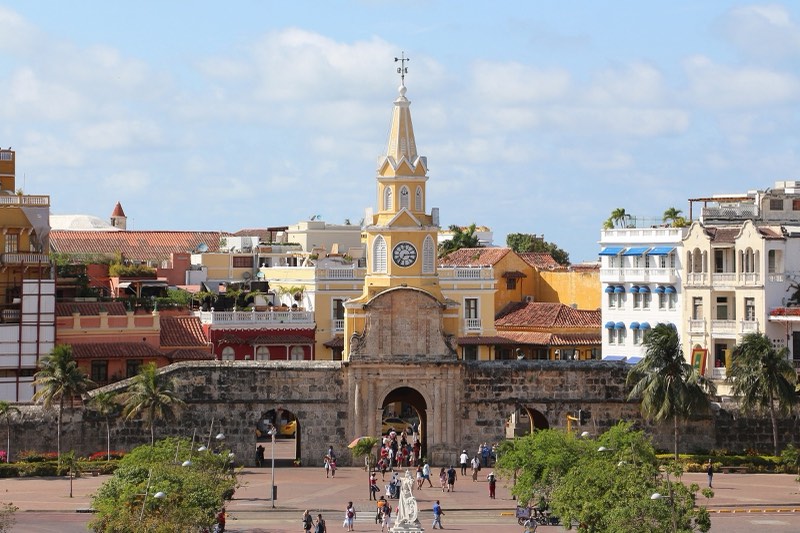
The yellow Clock Tower rises above the arched Puerta del Reloj, the main gate through the old city wall.Photo: Bernard Gagnon, CC BY-SA 4.0, via Wikimedia Commons - 0.7 km
Plaza de San Diego
North through Plaza Fernández de Madrid you reach San Diego, the northern barrio inside the walls. Its square, Plaza de San Diego, is where the loop turns west toward the wall.
- 1.1 km
Las Bóvedas
Las Bóvedas are 23 vaults built into the north wall, finished in 1798. They were built for storage and later held prisoners; today they are craft and souvenir shops under a long arcade. This is also where the evening walk ends, on the wall above.
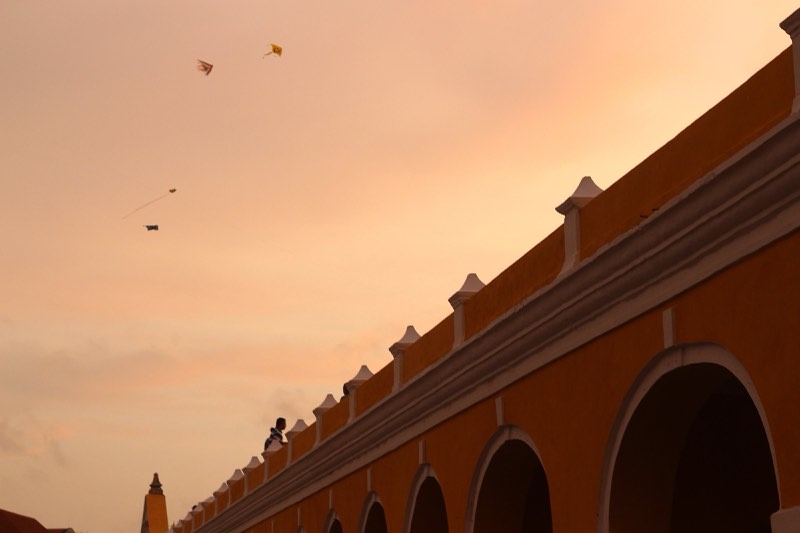
The arches of Las Bóvedas, built into the city walls, glow at sunset while kites fly overhead.Photo: Jami430, CC BY-SA 4.0, via Wikimedia Commons - 2.0 km
Teatro Adolfo Mejía
The pink theater on its own small plaza opened in 1911 for the first centenary of Cartagena’s independence. The old name, Teatro Heredia, is still carved over the balconies. See it from the plaza on the way west.
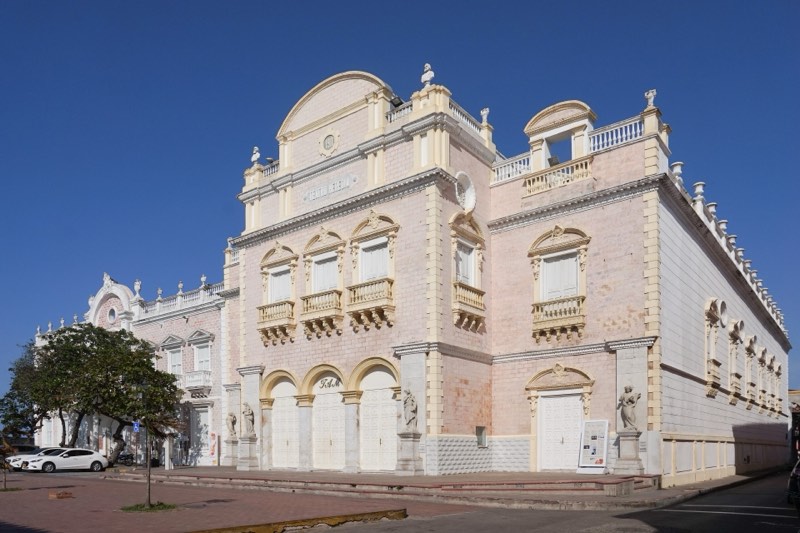
The Teatro Adolfo Mejía, still carved 'Teatro Heredia' above its balconies, on the small plaza north of Santo Domingo.Photo: Bernard Gagnon, CC BY-SA 4.0, via Wikimedia Commons - 2.4 km
Plaza Santo Domingo
Dominican friars began the Church of Santo Domingo in the 16th century. In its square lies Fernando Botero’s bronze reclining woman, Gertrudis, placed there in 2000. Café terraces line the square.
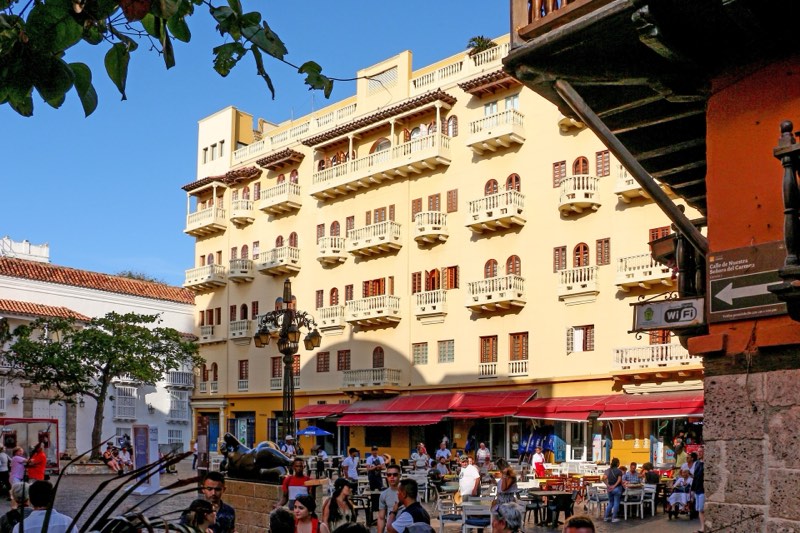
Late sun on Plaza Santo Domingo: café tables under the balconies, and Botero's reclining bronze Gertrudis at the lower left.Photo: Bernard Gagnon, CC BY-SA 4.0, via Wikimedia Commons - 2.6 km
The cathedral
The Cathedral of Santa Catalina de Alejandría was finished in 1612. Its orange and yellow bell tower rises above the rooftops.
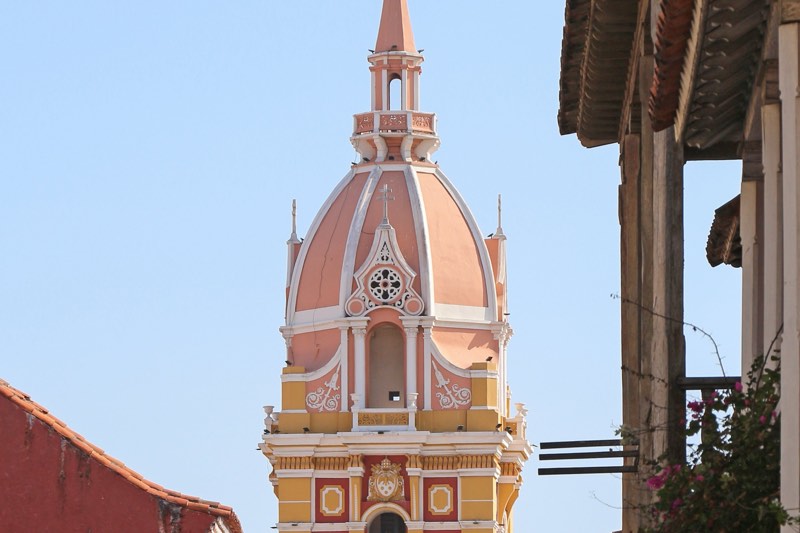
The cathedral's orange and yellow bell tower rises at the end of a narrow street of balconied houses.Photo: Bernard Gagnon, CC BY-SA 4.0, via Wikimedia Commons - 2.6 km
Plaza de Bolívar and the Inquisition palace
The shaded square with benches and the Bolívar statue is the place to sit under trees. On its west side, the Palacio de la Inquisición houses the city’s history museum (MUHCA); the Inquisition tribunal began its work in Cartagena in 1610. Adults pay 24,000 COP (about USD 7); hours are 9:00 to 18:00 Monday to Saturday and 10:00 to 16:00 on Sundays and holidays. The Museo del Oro Zenú of the central bank faces the same square.
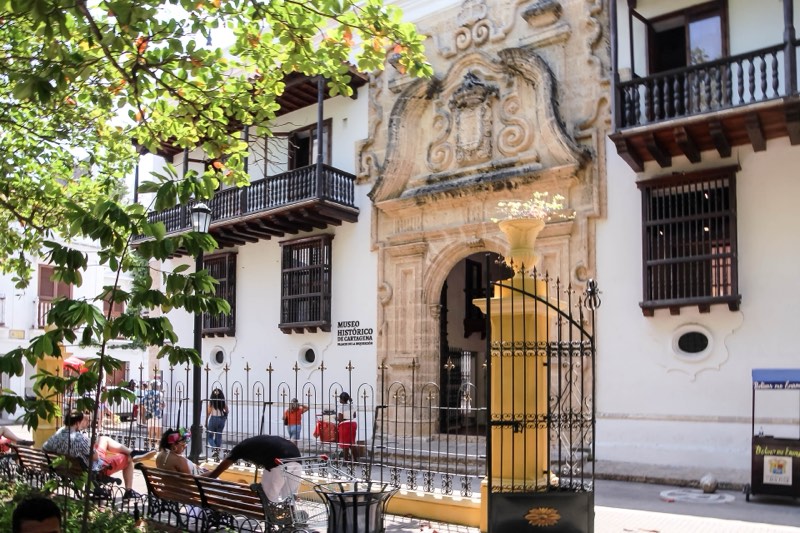
The carved stone portal of the Palacio de la Inquisición, now the Museo Histórico de Cartagena, behind the railings of Plaza de Bolívar.Photo: Dr. Thomas Liptak, CC BY-SA 4.0, via Wikimedia Commons - 2.9 km
San Pedro Claver
Pedro Claver was the Jesuit who served the enslaved Africans landed at this port; he died in 1654, was canonized in 1888, and his remains lie under the high altar. The church and museum charge foreign adults 30,000 COP (about USD 9), and 22,000 COP for foreign children, students and over-60s. The museum opens 9:00 to 16:30 Monday to Friday and 10:00 to 16:00 at weekends and on holidays.
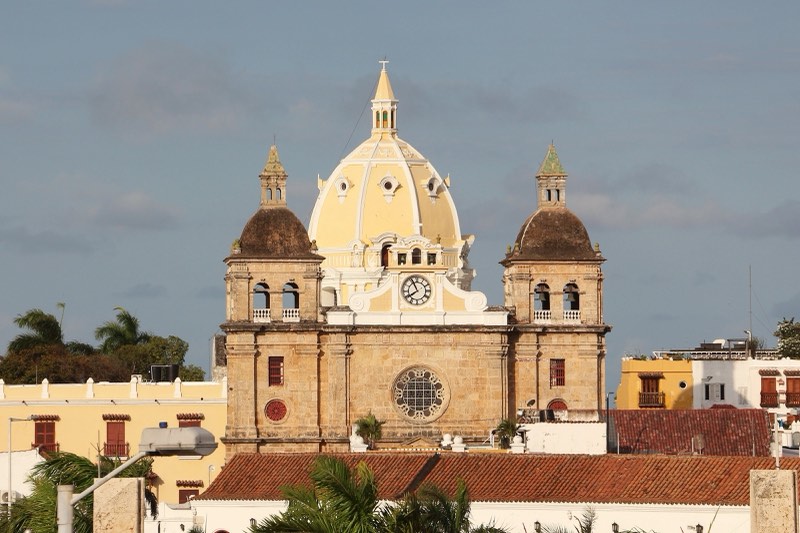
The stone facade, twin towers and dome of the San Pedro Claver church catch the early light above the rooftops.Photo: Bernard Gagnon, CC BY-SA 4.0, via Wikimedia Commons - 3.0 km
Plaza de la Aduana
The wide square named for the colonial customs house, lined with balconied houses and with a statue of Columbus, leads back to the Clock Tower gate. South of it, outside the wall, are the island boats at Muelle de la Bodeguita and the bay.
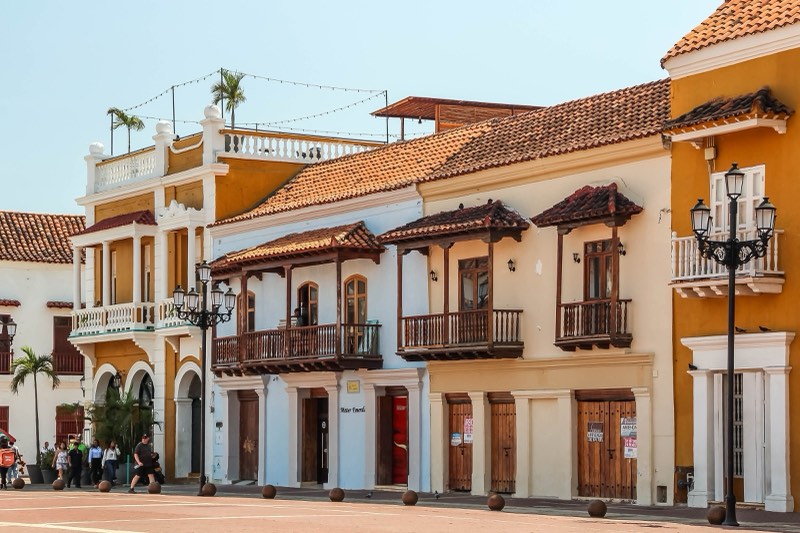
Painted colonial houses with wooden balconies face Plaza de la Aduana in the walled city.Photo: Dr. Thomas Liptak, CC BY-SA 4.0, via Wikimedia Commons


4Evening
Up on the walls for the sunset
Walking the walls is free and open to the public. The fort operator publishes no opening hours for them. The walls went up after Francis Drake took the city in 1586, around a city founded in 1533.
Baluarte de San Francisco Javier
Start at the bastion on the southwest corner, by the Naval Museum, about an hour before sunset. From here the wall runs north with the sea on your left.
Baluarte de Santo Domingo
The bastion that juts toward the open sea faces west over the water. The Café del Mar bar that stood on it was cleared from 2 September 2024, and the bastion has been a public space again since 24 May 2025. Be here half an hour before sunset. Toilets on the wall here and at Las Bóvedas cost 1,500 COP (2025 rate). For rooftops and boats instead, see where to watch the sunset.
Baluarte de Santa Catalina
Keep walking north in the dusk to the bastion at the far corner, above Las Bóvedas. Come down into San Diego for dinner: what to eat in Cartagena.
From December to April the evening walk falls inside the line with time to spare. From May to November it does not: the wall still feels like 33 to 34 °C with the breeze at 18:00 in May, June, September and October. Go up for the sunset, carry water, and keep it short.


5Ship days
When the cruise ships are in
From October to April, cruise ships change the old town for the middle of the day. Most dock between 7:00 and 8:00 (91 of 167 calls in the 2026-27 schedule), and the typical ship sails at 18:00. The port schedule lists every call. Passengers reach the walled city after the trip in from the terminal and head back well before sailing, so expect the plazas and the Clock Tower gate busiest from about 9:00 to 15:00.
The morning loop already finishes before then in most months. On a ship day, be inside San Pedro Claver at 9:00, or leave it for after 15:00 on a weekday. The walls at sunset are after the ships have gone.
Ship days by month, September 2026 to June 2027
- Sep6
- Oct11
- Nov15
- Dec18
- Jan22
- Feb17
- Mar14
- Apr17
- May2
- Jun3


Busiest day in JanuaryThe 2027 schedule’s busiest January day, 24 January, has three ships with up to 4,162 passengers.
Arriving by ship?The terminal is 3.2 km from the walled city. The cruise port page plans the hours ashore.
6Guide or not
With a guide, or with the map
You do not need a guide to walk the walled city. The loop is 3.1 km on short streets inside the walls, and the walls are free. What a guide adds is the story behind the houses and the plazas. If you want that, book it for your first morning and choose the earliest start, so the walk falls in the cool hours.
- The Historic Center and Getsemaní shared walking tour works on tips, meets at Plaza Cervantes by the Camellón de los Mártires, and continues into Getsemaní.
- The Walled City and Getsemaní shared walking tour starts at Plaza de Santo Domingo, stop 5 on the loop.
- The walled city group tour with live audio uses a live audio system, which helps in noisy plazas.
- The Walled City and Getsemaní private tour is for your group only and includes pickup.
- To eat your way around instead, the street food tour in the walled city also meets at Plaza Cervantes.
More options, from bay cruises to day trips, are on things to do in Cartagena.
FortCastillo San Felipe, the fortress on the hill east of Getsemaní, has its own cool windows: Castillo San Felipe.
7Around it
Gates, neighbors and where to sleep
The walled city is part of the UNESCO World Heritage property Port, Fortresses and Group of Monuments, Cartagena, listed in 1984. Inside the walls are two barrios: Centro, around the cathedral and the big plazas, and San Diego to the north. East of the Clock Tower gate lies La Matuna. The wall on that side, from the gate to the San Pedro Mártir bastion, was pulled down in the early twentieth century (El Universal, Lonely Planet), and so was a stretch on the bay side by the Parque de la Marina, around the 1911 centenary of independence, according to El Universal. That is why the plan has no wall there.
Southeast across the Parque del Centenario is Getsemaní, the old barrio outside the main walls, busier at night and with its own murals and plazas. To compare sleeping inside the walls, in Getsemaní or by the beach, read where to stay in Cartagena. Before you go out after dark, the Cartagena safety page sums up the official advisories.
Airport taxi to Centro and San Diego20,200 COPThe official fare from Rafael Núñez airport in 2026 for zone 1 (about USD 6). The same table charges 24,300 COP to the old town’s hotel zone: ask which applies before you get in.
8Questions
Walled city questions
What is the walled city in Cartagena?
It is the colonial historic center of Cartagena, Colombia, enclosed by stone walls built after Francis Drake’s attack of 1586. Inside are the barrios of Centro and San Diego, with the Clock Tower gate, the cathedral, Plaza de Bolívar and San Pedro Claver. It is part of a UNESCO World Heritage property listed in 1984.
How long does it take to walk the walled city of Cartagena?
The loop on this page is 3.1 km, about 47 minutes of walking at an easy pace. With stops and one museum, plan on two to three hours, early in the morning. The sunset walk on the walls adds 1.6 km, about 24 minutes. In the wet months, start the loop at first light.
Is it free to walk on the walls of Cartagena?
Yes. The fort operator says the walk along the walls is free and open to the public. It publishes no opening hours. The paid stops are inside: the Inquisition palace museum (24,000 COP for adults) and San Pedro Claver (30,000 COP for foreign adults). Toilets on the walls cost 1,500 COP (2025 rate).
Do you need a guide for the walled city?
No. The streets inside the walls are short and the loop is drawn on the plan, so the map is enough to find your way. A guide adds the history behind the houses and plazas. Shared walking tours meet at Plaza Cervantes and Plaza de Santo Domingo; book the earliest start to avoid the heat.
What is the difference between the walled city and Getsemaní?
The walled city, Centro and San Diego, sits inside the colonial walls and holds the cathedral, the big plazas and the museums. Getsemaní lies just outside, to the southeast, across the Parque del Centenario. It has about as many mapped bars as Centro, the murals and Plaza de la Trinidad. Many visitors walk both in one day.
Sources
- Official taxi fare from Rafael Núñez airport (CTG), Cartagena, Colombia to Centro - San Diego - La Matuna - Getsemaní (2026 table): 20,200 COP. OINAC: Tarifas taxis desde el Aeropuerto Internacional Rafael Núñez (footed 'Decreto 0051 Alcaldía Mayor de Cartagena').
- Official taxi fare from Rafael Núñez airport (CTG), Cartagena, Colombia to Centro - Zona hotelera Centro Histórico (2026 table): 24,300 COP. OINAC: Tarifas taxis desde el Aeropuerto Internacional Rafael Núñez (footed 'Decreto 0051 Alcaldía Mayor de Cartagena').
- Cruise terminal of Cartagena, Colombia: distance to the Centro Histórico (walled city): 3.2 km. SPRC / Grupo Puerto de Cartagena: Terminal de Cruceros page (Wayback snapshot 2026-10-17).
- Toilets on the city walls of Cartagena, Colombia (Las Bóvedas, Baluarte Santo Domingo, San Juan Evangelista, San Miguel de Chambacú): price per person: 1500 COP. ETCAR (Fortificaciones de Cartagena): Política Tarifaria Versión 10, 2025-06-13.
- Palacio de la Inquisición / Museo Histórico de Cartagena (MUHCA), Cartagena, Colombia: adult entry (no national/foreign split): 24,000 COP. Museo Histórico de Cartagena de Indias (MUHCA): visit page.
- Palacio de la Inquisición / Museo Histórico de Cartagena (MUHCA), Cartagena, Colombia: children, students, teachers and older adults: 20,000 COP. Museo Histórico de Cartagena de Indias (MUHCA): visit page.
- Palacio de la Inquisición / Museo Histórico de Cartagena (MUHCA), Cartagena, Colombia: opening hours Monday to Saturday: 9:00 to 18:00. Museo Histórico de Cartagena de Indias (MUHCA): visit page.
- Palacio de la Inquisición / Museo Histórico de Cartagena (MUHCA), Cartagena, Colombia: opening hours Sundays and holidays: 10:00 to 16:00. Museo Histórico de Cartagena de Indias (MUHCA): visit page.
- Santuario y Museo San Pedro Claver, Cartagena, Colombia: international adult entry: 30,000 COP. Santuario y Museo San Pedro Claver: Tarifas y horarios, 2026-02-05.
- Santuario y Museo San Pedro Claver, Cartagena, Colombia: foreign children, students and over-60s: 22,000 COP. Santuario y Museo San Pedro Claver: Tarifas y horarios, 2026-02-05.
- Santuario y Museo San Pedro Claver, Cartagena, Colombia: museum hours Monday to Friday: 9:00 to 16:30. Santuario y Museo San Pedro Claver: Tarifas y horarios, 2026-02-05.
- Santuario y Museo San Pedro Claver, Cartagena, Colombia: museum hours Saturday, Sunday and holidays: 10:00 to 16:00. Santuario y Museo San Pedro Claver: Tarifas y horarios, 2026-02-05.
- Port, Fortresses and Group of Monuments, Cartagena, Colombia (UNESCO World Heritage): year inscribed: 1984. UNESCO open data API, dataset whc001 (World Heritage List), id_no 285.
- Café del Mar, bar on the Baluarte de Santo Domingo, Cartagena, Colombia: day the city began the eviction and recovery of the bastion: 2 September 2024. El Heraldo: Café del Mar perdió otra batalla jurídica en Cartagena (19 Sep 2024); second source El Tiempo: Café del Mar pierde último recurso (22 Oct 2024), 2024-09-19.
- Baluarte de Santo Domingo, Cartagena, Colombia: day it reopened as a public space with a restaurant run by the Escuela Taller Cartagena de Indias (Etcar): 24 May 2025. El Universal: El Baluarte Santo Domingo abre sus puertas con gastronomía y cultura (25 May 2025); second source El Universal: Así funcionará el Baluarte Santo Domingo (28 May 2025), 2025-05-25.
- Puerta del Reloj, Cartagena, Colombia (main gate of the walled city): year a clock was first installed in the gate tower: 1874. Colombia Travel (ProColombia): Gate and Clock Tower; second source El Universal: La Boca del Puente, la puerta principal.
- Plaza de los Coches, Cartagena, Colombia: historic use: market square where enslaved people were auctioned and sold. Museo Histórico de Cartagena (MUHCA): Cartapedia, Plaza de los Coches.
- Cartagena de Indias, Colombia: year Pedro de Heredia founded the city: 1533. ETCAR (Fortificaciones de Cartagena): Murallas de Cartagena; Banco de la República, Enciclopedia Banrepcultural: Pedro de Heredia.
- Camellón de los Mártires, Cartagena, Colombia: year the nine patriots shown in its busts were executed: 1816. Radio Nacional de Colombia: Independencia de Cartagena, la historia de nueve mártires; El Universal: Bancas del Camellón de los Mártires.
- San Pedro Claver, the Jesuit of the Cartagena sanctuary, Colombia: year of death: 1654. Santuario y Museo San Pedro Claver: home page (biography block).
- San Pedro Claver, Cartagena, Colombia: year canonised: 1888. Santuario y Museo San Pedro Claver: home page (biography block).
- Church of San Pedro Claver, Cartagena, Colombia: where the saint's remains are kept: under the high altar. Santuario y Museo San Pedro Claver: el santuario, un espacio para la peregrinación.
- Tribunal of the Holy Office (Inquisition) in Cartagena, Colombia: year it began work in the city: 1610. Museo Histórico de Cartagena (MUHCA): Conócenos.
- Cathedral of Santa Catalina de Alejandría, Cartagena, Colombia: year construction was finished: 1612. El Heraldo: Arzobispo de Cartagena cierra la catedral; en.wikipedia: Cartagena Cathedral, 2016-03-02.
- Church of Santo Domingo, Cartagena, Colombia: century its construction began: 16th century. Colombia Travel (ProColombia): tour of the historic center; El Rincón Colombiano: Plaza de Santo Domingo.
- Plaza Santo Domingo, Cartagena, Colombia: year Fernando Botero's reclining figure 'Gertrudis' was installed: 2000. Portafolio: Fernando Botero, lugares donde puede ver las obras; El Rincón Colombiano: Plaza de Santo Domingo.
- Teatro Adolfo Mejía (former Teatro Heredia), Cartagena, Colombia: year it opened, for the first centenary of the city's independence: 1911. El Universal: Piden que obras en el Teatro Adolfo Mejía finalicen antes de noviembre (2025); es.wikipedia: Teatro Adolfo Mejía, 2025-06-04.
- Las Bóvedas, Cartagena, Colombia: year the works were finished: 1798. El Tiempo: el plan que adelanta la Nación para recuperar monumentos y fortificaciones; en.wikipedia: Las Bóvedas.
- Las Bóvedas, Cartagena, Colombia: number of vaults: 23. en.wikipedia: Las Bóvedas; El Tiempo (as HIS-WALLE-014).
- Sir Francis Drake's attack on Cartagena, Colombia, after which the city walls were built: 1586. Banco de la República: Cartagena (toma y saqueo de Francis Drake en 1586); ETCAR: Murallas de Cartagena.
- Colombian peso exchange rate (TRM) valid 2026-11-11: 3297.07 COP per USD. Superintendencia Financiera de Colombia: TRM, open dataset on datos.gov.co, 2026-11-11.
- Felt temperature by month and hour. NOAA NCEI Integrated Surface Database, station 800220 (Rafael Nunez airport, Cartagena), hourly observations, 2016 to 2024; medians per month and hour (Steadman apparent temperature, shade).
- Sunrise, sunset, sea and rain by month. Sunrise and sunset for the 15th of each month, UTC-5. Rain: IDEAM: Normales Climatológicas de Colombia 1991-2020, station 14015080 Aeropuerto Rafael Núñez, mean days with 1 mm or more and mean millimetres per month. Sea: typical values from the Open-Meteo Marine model, 2016 to 2025 (CC BY 4.0).
- Ship days. Sociedad Portuaria Regional de Cartagena, Programación de Cruceros 2026-27 (PDF updated 2026-11-03).
Photographs
- Torre del Reloj above the Puerta del Reloj, the main gate in the city wall. Photo: Bernard Gagnon, CC BY-SA 4.0, via Wikimedia Commons
- Teatro Adolfo Mejía (Teatro Heredia), pink stone facade. Photo: Bernard Gagnon, CC BY-SA 4.0, via Wikimedia Commons
- Plaza Santo Domingo with café tables and Botero's reclining Gertrudis. Photo: Bernard Gagnon, CC BY-SA 4.0, via Wikimedia Commons
- Tower of the Cathedral of Santa Catalina de Alejandría framed by a colonial street. Photo: Bernard Gagnon, CC BY-SA 4.0, via Wikimedia Commons
- Carved stone portal of the Palacio de la Inquisición on Plaza de Bolívar. Photo: Dr. Thomas Liptak, CC BY-SA 4.0, via Wikimedia Commons
- Dome and towers of the Church of San Pedro Claver. Photo: Bernard Gagnon, CC BY-SA 4.0, via Wikimedia Commons
- Colonial facades with wooden balconies on Plaza de la Aduana. Photo: Dr. Thomas Liptak, CC BY-SA 4.0, via Wikimedia Commons
- Arcade of Las Bóvedas below the walls at sunset, with kites in the sky. Photo: Jami430, CC BY-SA 4.0, via Wikimedia Commons
- Brick walkway on top of the city walls, with the Caribbean on the left. Photo: Bernard Gagnon, CC BY-SA 4.0, via Wikimedia Commons
- Baluarte de Santo Domingo with the sea behind. Photo: Bernard Gagnon, CC BY-SA 4.0, via Wikimedia Commons
- Bocagrande skyline seen from the Baluarte de Santiago on the city walls. Photo: Mariordo (Mario Roberto Durán Ortiz), CC BY-SA 4.0, via Wikimedia Commons
- Two cruise ships in the Bay of Cartagena, one docked at the port and one arriving. Photo: Joe Ross, CC BY-SA 2.0, via Wikimedia Commons