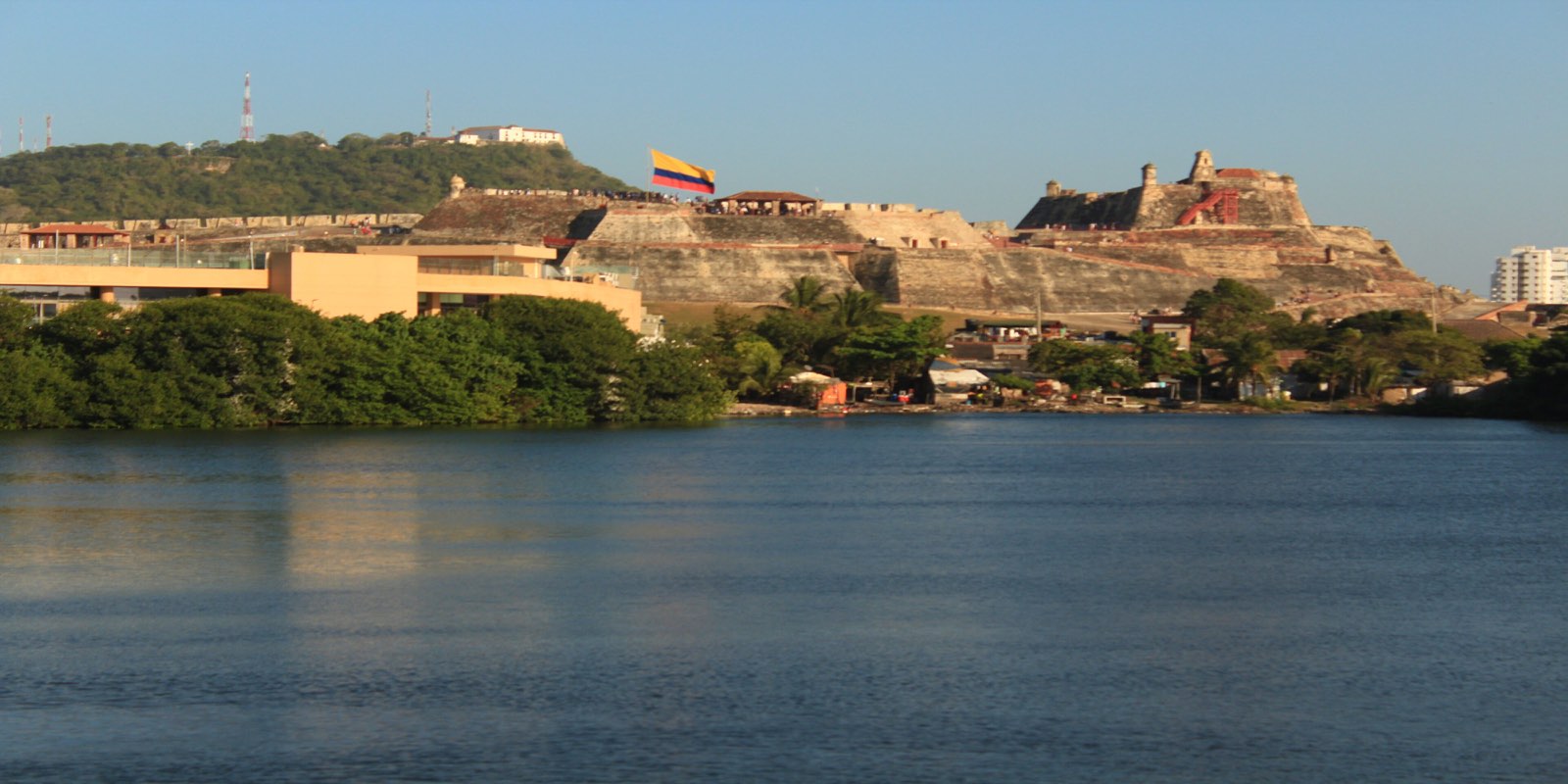
Castillo San Felipe de Barajas
The Spanish fortress on San Lázaro hill is a climb up steep ramps and stairs, and the operator warns that the heat is intense in the middle of the day. When to go depends on the month.
Photo: Felipe Ortega Grijalba, CC BY-SA 4.0, via Wikimedia Commons
Castillo San Felipe de Barajas is the Spanish colonial fortress on San Lázaro hill in Cartagena, Colombia, facing the old town. Entry for a foreign adult is 38,000 COP in 2026 (about USD 12), and it opens Monday to Sunday, 7:00 to 18:00. On the open hill, with the breeze, February typically stays below the guide’s 33 °C (91 °F) line until about 9:30 and, after the high sun, again from 15:30. From May to October it is at or past that line by about 7:15 at the latest: go at opening and keep the visit short.
I visited the fortress on my trip to Cartagena in October 2023. Rainer Lang, editor
Some links on this page are affiliate links: the guide earns a commission when you book through them. The partner sets the price; the guide adds no fee.
At a glance
- Foreign adult, 2026
- 38,000 COPabout USD 12
- With a cédula
- 33,000 COP with a Colombian cédula or cédula de extranjería
- Reduced
- 16,000 COP (about USD 5) for children 6 to 13, students and teachers with a valid card. Children under 6: free
- Hours
- Monday to Sunday, 7:00 to 18:00
- Time to allow
- About 75 minutes for the ramps, the tunnels and the top (the guide’s allowance; the operator gives none)
- Tickets
- At the ticket office, or at the operator’s online shop
- Guides
- Not included in the ticket; guides can be hired at the fort's ticket office
The feeThe fee rises every 15 January with Colombian inflation, rounded up to the next thousand pesos. Any rate below 38,000 COP is sold only at the ticket office, with ID. Dollar figures use 3,297 COP per USD (November 2026).
1The visit
The visit, part by part
Blas de Lezo, at the foot
The statue in the gardens outside the fortress shows the Spanish admiral Blas de Lezo, who defended Cartagena de Indias in 1741, when a British force attacked the city.
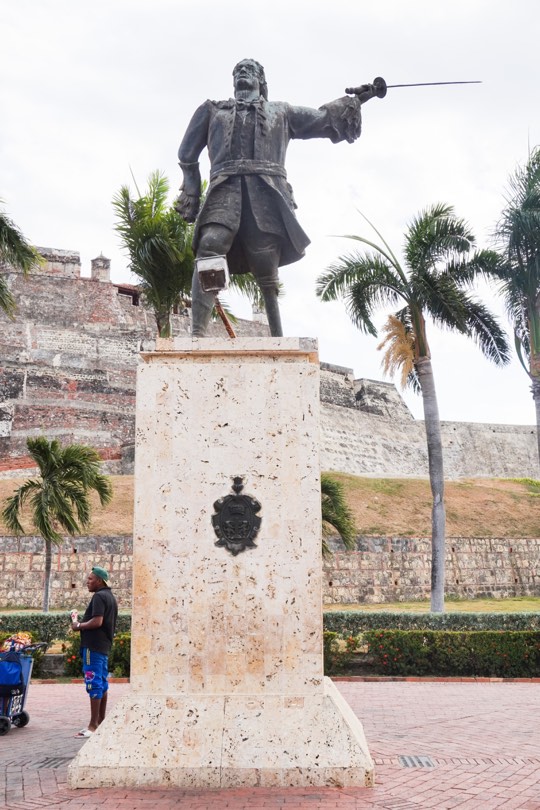
The bronze statue of Blas de Lezo, sword raised, stands on a stone pedestal in front of the fortress.Photo: Bernard Gagnon, CC BY-SA 4.0, via Wikimedia Commons The ramps
The way up is a run of steep ramps and stairs. The operator’s advice: comfortable clothes and shoes; some forts have steep ramps and stairs; and on the heat, the heat can be intense, especially in the middle hours of the day; use sun protection and drink water. The main gate with a drawbridge, joined to a stone staircase by a palisade with a covered path, dates from 1715; a covered palisade halfway up from 1724.
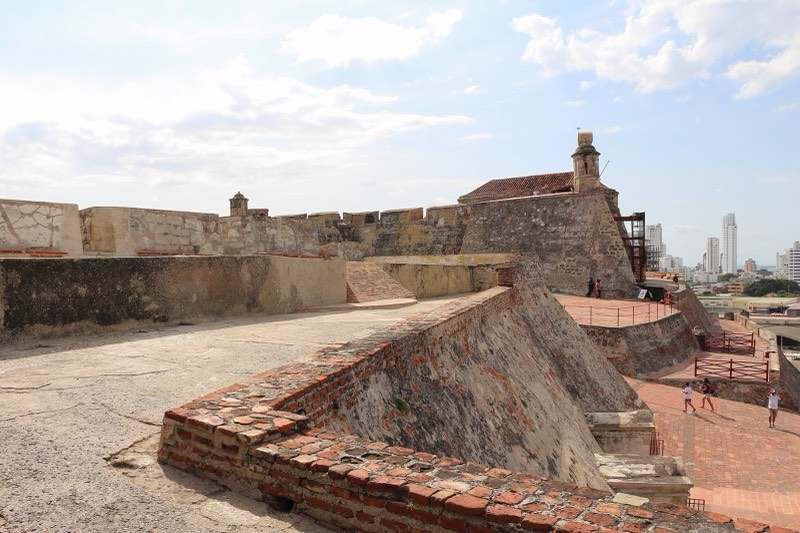
Sloping brick ramps climb between the angled stone walls toward the upper levels of the fortress.Photo: Bernard Gagnon, CC BY-SA 4.0, via Wikimedia Commons San Lázaro battery, the south side
Its 5 cannons covered San Lázaro beach and the Cocal swamp. A battery of kindling sticks first defended this side in 1739; Antonio de Arévalo built the outer batteries in 1762 to 1769. In 1969 this battery, which held the castle’s three deep cisterns, caved in, and the castle was partly rebuilt.
San Lázaro
Santa Bárbara and La Redención, facing La Popa
Santa Bárbara was built about 1762; its 7 cannons could reach La Popa, the hill to the east. La Redención, between Santa Bárbara and La Cruz, guarded the approach from El Cabrero with 11 cannons.
Santa Bárbara La Redención
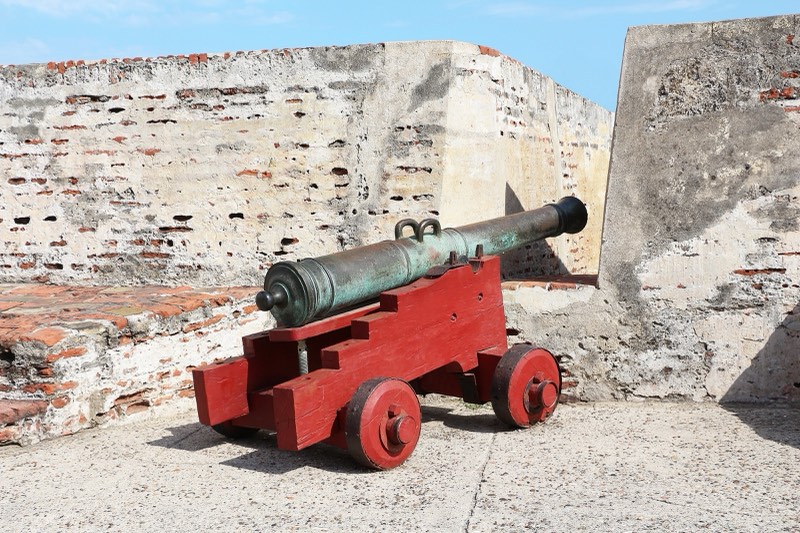
A bronze cannon on a red wooden carriage points out from a stone battery of the fortress.Photo: Bernard Gagnon, CC BY-SA 4.0, via Wikimedia Commons The Hornwork, La Cruz and San Carlos, the north side
The Hornwork faces north, with 6 cannons; La Cruz the northwest, with 8. San Carlos y Los Apóstoles had the greatest firepower, 13 cannons, and is reached from beneath the Hornwork. In all the batteries carried 63 cannons, placed so that no battery could be taken without fighting the whole fortress.
Hornwork La Cruz San Carlos
The tunnels
Arévalo’s works underground: galleries and covered passages for troop movement, underground barracks for 350 men in a siege, and a large hall almost at sea level dividing into blind alleys where explosives could be placed against troops approaching. The operator notes that the tunnels can be slippery.
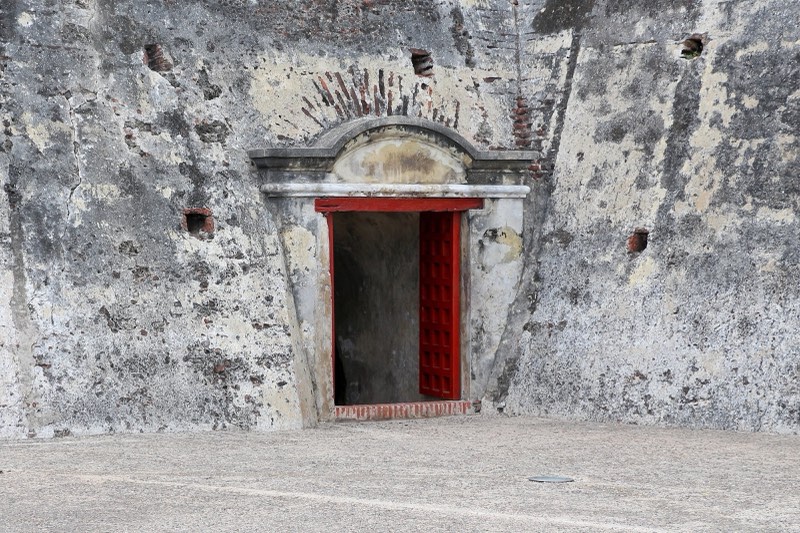
A red-framed doorway leads into the fortress tunnels through a weathered coral-stone wall.Photo: Bernard Gagnon, CC BY-SA 4.0, via Wikimedia Commons The top: the first fort
The summit held the first fort, finished on 12 October 1657: a triangular bonnet at the top of the hill with four sentry boxes, a cistern, a warehouse and barracks for 20 soldiers and four artillerymen. From the top the hill looks down on the walled city and Getsemaní.
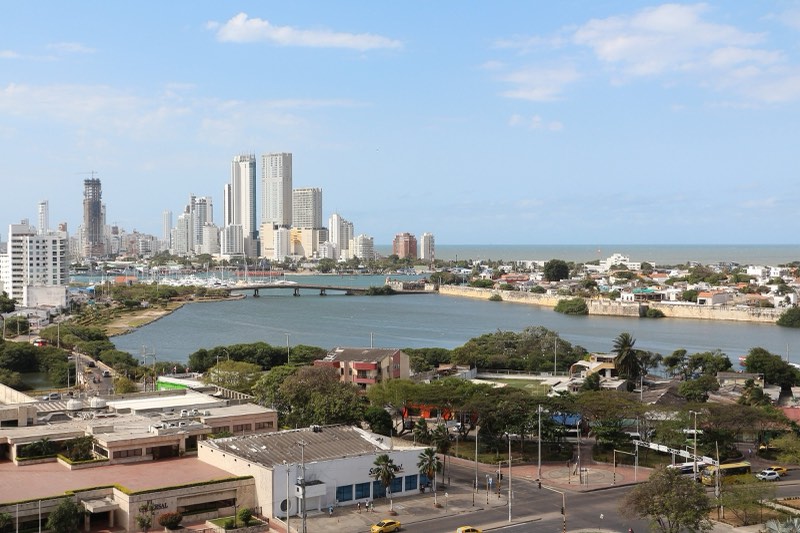
From the fortress, the view runs over the water and a section of the city walls to the Bocagrande high-rises.Photo: Bernard Gagnon, CC BY-SA 4.0, via Wikimedia Commons


2The hours
When to go
The hill is open ground with the breeze and no shade, so the guide judges it by the felt temperature with the breeze, at or below 33 °C (91 °F), and never counts the high sun from 10:00 to 15:30: on the open ramps, in sun, it feels hotter than any shade figure. The line is the guide’s own. The strip above shows your month; the table, every month.
December to April. Opening is inside a cooler window, and after the high sun the afternoon breeze brings a second one: in February from 15:30 to closing. In December the afternoon window opens at about 16:00.
May to November. The breeze is weaker. From May to October it is at or past the line by about 7:15 at the latest, so go at 7:00 and keep it short; in November a short window comes back at the very end of the day.
Closing and sunset. The gates close at 18:00. In January, October, November, December the sun sets before that, between 17:37 and 17:58 on the 15th; in the other months it sets after closing.
| Month | 7:00 | 11:00 | 16:30 | Ship days | |||
|---|---|---|---|---|---|---|---|
| still | breeze | still | breeze | still | breeze | ||
| January | 30 (86) | 29 (84) | 36 (97) | 34 (93) | 35 (95) | 32 (90) | 22 |
| February | 30 (86) | 28 (82) | 36 (97) | 33 (91) | 35 (95) | 31 (88) | 17 |
| March | 31 (88) | 30 (86) | 36 (97) | 33 (91) | 35 (95) | 31 (88) | 14 |
| April | 33 (91) | 32 (90) | 37 (99) | 35 (95) | 36 (97) | 32 (90) | 17 |
| May | 35 (95) | 33 (91) | 38 (100) | 36 (97) | 38 (100) | 34 (93) | 2 |
| June | 34 (93) | 33 (91) | 38 (100) | 36 (97) | 37 (99) | 34 (93) | 3 |
| July | 34 (93) | 33 (91) | 38 (100) | 36 (97) | 37 (99) | 34 (93) | not in schedule |
| August | 34 (93) | 33 (91) | 38 (100) | 36 (97) | 37 (99) | 34 (93) | not in schedule |
| September | 35 (95) | 33 (91) | 38 (100) | 36 (97) | 37 (99) | 34 (93) | 6 |
| October | 34 (93) | 33 (91) | 37 (99) | 35 (95) | 36 (97) | 34 (93) | 11 |
| November | 33 (91) | 32 (90) | 37 (99) | 35 (95) | 36 (97) | 33 (91) | 15 |
| December | 31 (88) | 30 (86) | 37 (99) | 36 (97) | 36 (97) | 33 (91) | 18 |
Ship daysThe 2026-27 schedule lists 17 ship days in February 2027; July and August are outside it. The busiest February day, 10 February, has three ships with up to 6,766 passengers. Most ships dock between 7:00 and 8:00 (91 of 167 calls).
3Guide or not
With a guide or on your own
Going alone is simple: buy a ticket and follow the ramps up. A guide tells the story of the batteries and the tunnels; guides: Not included in the ticket; guides can be hired at the fort's ticket office.
On a tour, ask for the earliest start so the fortress falls in the cooler hours of your month.
- The La Popa and San Felipe tour includes the fortress ticket, entry to the Convento de La Popa, the Zapatos Viejos, a walled-city walk and hotel pickup in Zona Norte, Bocagrande and El Laguito.
- The bilingual city tour with San Felipe comes with a certified guide and pickup. It includes the fortress ticket, La Popa hill, Getsemaní, the vaults and a bay tour.
- The walled city, San Felipe and La Popa tour covers the three places in its name.
- The panoramic city tour comes with a certified guide and pickup, adding the India Catalina monument to the usual stops.
Panoramic city tour+38,000 COPThe panoramic city tour lists the fortress entrance as not included, so add 38,000 COP. The La Popa and bilingual tours include the ticket.
4Around it
Getting there and what is near
The fortress is on Avenida Antonio Arévalo, in Pie del Cerro, with parking on the avenue and on Calle 31 by the Botas Viejas monument. The operator gives the travel times as 15 minutes by car from Rafael Núñez airport and 10 minutes from the Clock Tower in the historic centre (mode not stated). From Getsemaní, the nearest barrio of the old town, see the Getsemaní page; taxis and buses: getting around Cartagena.
Airport taxi to Pie del Cerro28,500 COPThe official taxi fare from the airport to Pie del Cerro, the fortress district, in 2026 (about USD 9).
Zapatos Viejos
A sculpture of a pair of old shoes, a tribute to the Cartagena poet Luis Carlos López. Also called Botas Viejas, it stands on Calle 31, by the fortress parking.
Convento de La Popa
The convent on the hill to the east is run by the Augustinian Recollects (santuariolapopa.com). Santa Bárbara’s cannons could reach the hill.
Getsemaní
The barrio between the fortress and the walled city. See the Getsemaní page for when to go.
5History
A short history
An enemy on San Lázaro hill could fire down into the walled city. The dates below are the operator’s own, from its history pages.
The dates, 1639 to 1984
- 1639Governor Melchor Aguilera saw the need for a work on the hill, but the Royal Treasury’s officials refused the money.
- 1657Governor Pedro Zapata finished the first small fort on 12 October 1657, to the plan of the Dutchman Ricardo Carr. It was named for King Felipe IV and the governor's ancestors, the Counts of Barajas.
- 1697The Baron de Pointis took the fort on 20 April 1697, and the city was plundered soon after.
- 1741The British attack under Admiral Edward Vernon: after a siege of the city and bay of more than a month and the taking of the Bocachica forts, an attack on the better-defended flank by troops weakened by tropical illness, which failed to take the castle.
- 1762After England took Havana, Antonio de Arévalo built the outer batteries and tunnels, 1762 to 1769.
- 1887After independence the fortress was abandoned and used as a quarry for several decades; ownership transferred to the Republic of Colombia on 22 August 1887.
- 1928The Society for Public Improvements had it restored.
- 1984UNESCO listed it with the Port, Fortresses and Group of Monuments of Cartagena.
6Questions
Questions people ask
How much is entry to Castillo San Felipe?
A foreign adult pays 38,000 COP in 2026, about USD 12. With a Colombian cédula or cédula de extranjería it is 33,000 COP. Children 6 to 13, and students and teachers with a valid card, pay 16,000 COP. Under 6 is free. Free entry on the last Sunday of each month except January and December is for Colombians (cédula de ciudadanía) and resident foreigners (cédula de extranjería) only; foreign tourists pay.
What is the best time to visit Castillo San Felipe?
It depends on the month. On the open hill, with the breeze, February stays cooler than the guide’s line until about 9:30 and again from 15:30. From May to October go at 7:00, when it opens, and keep it short. The operator warns that the heat is intense in the middle of the day.
What happened at Castillo San Felipe?
It was finished in 1657 so that no enemy could use San Lázaro hill to fire on the city. A French force under the Baron de Pointis took the first small fort in 1697. In 1741 a British force under Edward Vernon attacked it after a siege of more than a month and failed to take it; Arévalo then added the outer batteries and tunnels.
What are the forts of Cartagena called?
On the mainland: Castillo San Felipe de Barajas and the city walls, which are free to walk. At Bocachica, on the channel into the bay: Fuerte de San Fernando, Fuerte de San José and the Batería del Ángel San Rafael, open every day from 8:00 to 17:00.
Sources
- Official taxi fare from Rafael Núñez airport (CTG), Cartagena, Colombia to Pie de la Popa - Pie del Cerro; El Espinal - Lo Amador (2026 table): 28,500 COP. OINAC: Tarifas taxis desde el Aeropuerto Internacional Rafael Núñez (footed 'Decreto 0051 Alcaldía Mayor de Cartagena').
- Castillo San Felipe de Barajas, Cartagena, Colombia: full rate (Tarifa Plena) for foreign adults and anyone without Colombian ID: 38000 COP. ETCAR (Fortificaciones de Cartagena): Resolución 005 of 9 Jan 2026, 2026-01-09.
- Castillo San Felipe de Barajas, Cartagena, Colombia: rate for nationals (Colombian cédula, physical or digital, or Colombian cédula de extranjería): 33,000 COP. ETCAR (Fortificaciones de Cartagena): Resolución 005 of 9 Jan 2026, 2026-01-09.
- Castillo San Felipe de Barajas, Cartagena, Colombia: reduced rate (Tarifa Reducida) for children 6-13, students and teachers with a valid card: 16,000 COP. ETCAR (Fortificaciones de Cartagena): Resolución 005 of 9 Jan 2026, 2026-01-09.
- Castillo San Felipe de Barajas, Cartagena, Colombia: opening hours: Monday to Sunday, 7:00 to 18:00. ETCAR (Fortificaciones de Cartagena): visitor page Castillo de San Felipe de Barajas.
- Castillo San Felipe de Barajas, Cartagena, Colombia: free Sunday (Domingo Libre) schedule: last Sunday of each month except January and December. ETCAR (Fortificaciones de Cartagena): visitor page Castillo de San Felipe de Barajas.
- Castillo San Felipe de Barajas, Cartagena, Colombia: who gets free Sunday entry: Colombians (cédula de ciudadanía) and resident foreigners (cédula de extranjería) only; foreign tourists pay. ETCAR (Fortificaciones de Cartagena): visitor page Castillo de San Felipe de Barajas.
- Castillo San Felipe de Barajas, Cartagena, Colombia: guides: Not included in the ticket; guides can be hired at the fort's ticket office. ETCAR (Fortificaciones de Cartagena): visitor page Castillo de San Felipe de Barajas.
- Bocachica forts (San Fernando, San José, Batería del Ángel San Rafael), Tierra Bomba, Cartagena, Colombia: opening hours, Monday to Sunday, per the operator's visitor page: 8:00 to 17:00. ETCAR (Fortificaciones de Cartagena): visitor page Fortificaciones de Bocachica.
- Port, Fortresses and Group of Monuments, Cartagena, Colombia (UNESCO World Heritage): year inscribed: 1984. UNESCO open data API, dataset whc001 (World Heritage List), id_no 285.
- Castillo San Felipe de Barajas, Cartagena, Colombia: year Governor Melchor Aguilera first sought a work on the hill, refused funds by the Royal Treasury officials: 1639. ETCAR (fort operator): The Bonnet (1657-1697).
- Castillo San Felipe de Barajas, Cartagena, Colombia: date Governor Pedro Zapata finished the first fort, to the plan of the Dutchman Ricardo Carr: 12 October 1657. ETCAR (fort operator): The Bonnet (1657-1697).
- Castillo San Felipe de Barajas, Cartagena, Colombia: origin of the name: King Felipe IV and the governor's ancestors, the Counts of Barajas. ETCAR (fort operator): The Bonnet (1657-1697).
- Castillo San Felipe de Barajas, Cartagena, Colombia: date the Baron de Pointis took the first fort, before the city was plundered: 20 April 1697. ETCAR (fort operator): The Bonnet (1657-1697).
- Castillo San Felipe de Barajas, Cartagena, Colombia: year the main entrance with a drawbridge, joined to the stone staircase by a palisade with a covered path, was added: 1715. ETCAR (fort operator): Reconstruction and extension (1697-1741).
- Castillo San Felipe de Barajas, Cartagena, Colombia: year engineer Herrera y Sotomayor added a covered palisade in the middle of the hill: 1724. ETCAR (fort operator): Reconstruction and extension (1697-1741).
- Castillo San Felipe de Barajas, Cartagena, Colombia: year a hornwork of kindling sticks was added and the San Lázaro beach defended by another battery, fearing an English attack: 1739. ETCAR (fort operator): Reconstruction and extension (1697-1741).
- Castillo San Felipe de Barajas, Cartagena, Colombia: Vernon's attack of 1741: after a siege of the city and bay of more than a month and the taking of the Bocachica forts, an attack on the better-defended flank by troops weakened by tropical illness, which failed to take the castle. ETCAR (fort operator): Vernon's Attack (1741).
- Castillo San Felipe de Barajas, Cartagena, Colombia: years Antonio de Arévalo built the collateral batteries, after England took Havana in 1762: 1762 to 1769. ETCAR (fort operator): San Felipe after Vernon (1741-1769).
- Castillo San Felipe de Barajas, Cartagena, Colombia: cannons on the batteries after Arévalo, placed so that no battery could be taken without involving the whole complex: 63. ETCAR (fort operator): San Felipe after Vernon (1741-1769).
- Castillo San Felipe de Barajas, Cartagena, Colombia: Arévalo's underground works: galleries and covered passages for troop movement, underground barracks for 350 men in a siege, and a large hall almost at sea level dividing into blind alleys where explosives could be placed against troops approaching. ETCAR (fort operator): San Felipe after Vernon (1741-1769).
- Castillo San Felipe de Barajas, Cartagena, Colombia: after independence: abandoned and used as a quarry for several decades; ownership transferred to the Republic of Colombia on 22 August 1887. ETCAR (fort operator): XIX and XX Centuries.
- Castillo San Felipe de Barajas, Cartagena, Colombia: year the Society for Public Improvements contracted Carlos Crismatt to restore the fortress: 1928. ETCAR (fort operator): XIX and XX Centuries.
- Castillo San Felipe de Barajas, Cartagena, Colombia: year the San Lázaro battery, with the castle's three deep cisterns, caved in from faults in the ground; the castle was partly rebuilt: 1969. ETCAR (fort operator): XIX and XX Centuries.
- Castillo San Felipe de Barajas, Cartagena, Colombia: the first fort: a triangular bonnet at the top of the hill with four sentry boxes, a cistern, a warehouse and barracks for 20 soldiers and four artillerymen. ETCAR (fort operator): Areas of the Castle.
- Castillo San Felipe de Barajas, Cartagena, Colombia: San Lázaro battery, south side, covering San Lázaro beach and the Cocal swamp: cannons: 5. ETCAR (fort operator): Areas of the Castle.
- Castillo San Felipe de Barajas, Cartagena, Colombia: Santa Bárbara battery, built about 1762, able to reach La Popa: cannons: 7. ETCAR (fort operator): Areas of the Castle.
- Castillo San Felipe de Barajas, Cartagena, Colombia: La Redención battery, between La Cruz and Santa Bárbara, defending the access from El Cabrero: cannons: 11. ETCAR (fort operator): Areas of the Castle.
- Castillo San Felipe de Barajas, Cartagena, Colombia: Hornwork battery, north side: cannons: 6. ETCAR (fort operator): Areas of the Castle.
- Castillo San Felipe de Barajas, Cartagena, Colombia: San Carlos y Los Apóstoles battery, north side, reached from beneath the Hornwork, the greatest firepower: cannons: 13. ETCAR (fort operator): Areas of the Castle.
- Castillo San Felipe de Barajas, Cartagena, Colombia: La Cruz battery, northwest, built 1762 to 1769: cannons: 8. ETCAR (fort operator): Areas of the Castle.
- Castillo San Felipe de Barajas, Cartagena, Colombia: height of San Lázaro hill at its highest point: 40. ETCAR (fort operator): Areas of the Castle.
- Castillo San Felipe de Barajas, Cartagena, Colombia: the statue in the outside gardens: the Spanish admiral Blas de Lezo, who defended Cartagena de Indias in 1741. Wikipedia (es): Castillo San Felipe de Barajas.
- Colombian peso exchange rate (TRM) valid 2026-11-11: 3297.07 COP per USD. Superintendencia Financiera de Colombia: TRM, open dataset on datos.gov.co, 2026-11-11.
- Castillo San Felipe de Barajas, Cartagena, Colombia: the operator's advice on heat: the heat can be intense, especially in the middle hours of the day; use sun protection and drink water. ETCAR (fort operator): Recomendaciones.
- Castillo San Felipe de Barajas, Cartagena, Colombia: the operator's advice on clothing: comfortable clothes and shoes; some forts have steep ramps and stairs. ETCAR (fort operator): Recomendaciones.
- Castillo San Felipe de Barajas, Cartagena, Colombia: the operator on the tunnels: the tunnels can be slippery. ETCAR (fort operator): Recomendaciones.
- Castillo San Felipe de Barajas, Cartagena, Colombia: travel times stated by the operator: 15 minutes by car from Rafael Núñez airport and 10 minutes from the Clock Tower in the historic centre (mode not stated). ETCAR (fort operator): Castillo de San Felipe de Barajas, planee su visita.
- Felt temperature by month and hour. NOAA NCEI Integrated Surface Database, station 800220 (Rafael Nunez airport, Cartagena), hourly observations, 2016 to 2024; medians per month and hour (Steadman apparent temperature, shade).
- Ship days. Sociedad Portuaria Regional de Cartagena, Programación de Cruceros 2026-27 (PDF updated 2026-11-03).
- Sunrise, sunset, sea and rain by month. Sunrise and sunset for the 15th of each month, UTC-5. Rain: IDEAM: Normales Climatológicas de Colombia 1991-2020, station 14015080 Aeropuerto Rafael Núñez, mean days with 1 mm or more and mean millimetres per month. Sea: typical values from the Open-Meteo Marine model, 2016 to 2025 (CC BY 4.0).
Photographs
- The fortress and La Popa hill seen across the water. Photo: Felipe Ortega Grijalba, CC BY-SA 4.0, via Wikimedia Commons
- Statue of Blas de Lezo in front of the fortress. Photo: Bernard Gagnon, CC BY-SA 4.0, via Wikimedia Commons
- Sloping ramps and walls on the fortress. Photo: Bernard Gagnon, CC BY-SA 4.0, via Wikimedia Commons
- Bronze cannon on a red wooden carriage. Photo: Bernard Gagnon, CC BY-SA 4.0, via Wikimedia Commons
- Tunnel doorway set in the weathered stone wall. Photo: Bernard Gagnon, CC BY-SA 4.0, via Wikimedia Commons
- View from the fortress over the lagoon to Bocagrande. Photo: Bernard Gagnon, CC BY-SA 4.0, via Wikimedia Commons